
There are two types of MOSFETS: depletion-type MOSFETs and enhancement-type MOSFETs.
Enhancement-type MOSFETS are MOSFETs that are normally off. When you connect an enhancement-type MOSFET, no current flows from drain to source when no voltage is applied to its gate. This is why it is called a normally off device.There is no current flow without a gate voltage.
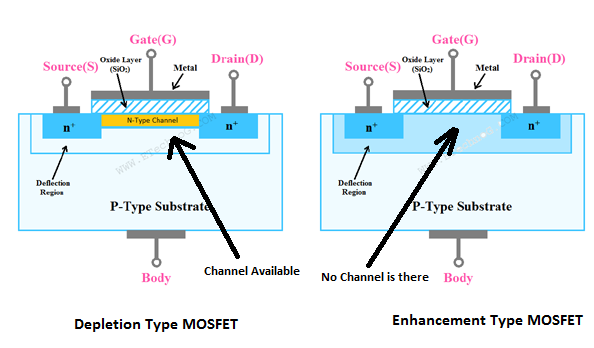
There are two types of MOSFETS: depletion-type MOSFETs and enhancement-type MOSFETs. Enhancement-type MOSFETS are MOSFETs that are normally off. When you connect an enhancement-type MOSFET, no current flows from drain to source when no voltage is applied to its gate. This is why it is called a normally off device. Thus, for an enhancement MOSFET, the channel does not exist at Vgs=0V and comes into play only when the threshold voltage, Vth is exceeded. This is the reason why it is called an Enhancement type MOSFET as the application of a voltage enhances the channel from a state of almost non-existence to a state of existence. Depletion Mode MOSFET.
- Question: Write With Proper Graphical Representation About Enhancement And Depletion Type Mosfet SHow The Construction Of CMOS And Explain How It Works. This problem has been solved! Show transcribed image text. Previous question Next question.
- Both enhancement- and depletion-mode MOSFETs are available with either n– or p-type channels. Enhancement-mode devices do not have a conducting channel built in; however, one can be created by the action of the gate. On the other hand, depletion-mode devices do have a built-in conducting channel that can be depleted by the action of the gate.

P Channel Enhancement Mode Mosfet
However, if a voltage is applied to the gate lead of the MOSFET, the drain-source channel becomesless resistive. As the gate-source voltage increases more and more, the current flowing from drain to source increasesmore and more, until maximum current is flowing from drain to source.
An enhancement-type MOSFET is so named an enhancement device, because as the voltage to the gate increases, the current increases more and more, until at maximum level.
An enhancement-type MOSFET behaves very similar in action to a bipolar junction transistor.
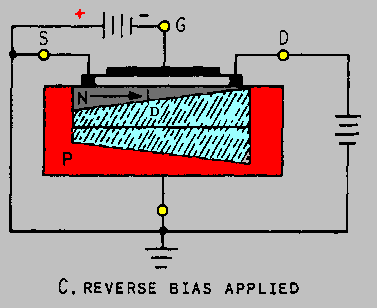
The other type of MOSFET, a depletion-type MOSFET, has the complete opposite behavior. Depletion MOSFETsare normally on devices. They conduct current at maximum level when there is no voltage applied to the gate lead. with a depletion-type MOSFET, as you increase the gate-source voltage, the drain-source channel of the transistor becomes more resistive and the current flowing from drain to source decreases, and if the gate-source voltage reachesthe cutoff level, the current completely ceases to flow.
In this tutorial, we will learn about the working of a MOSFET as a Switch. In the MOSFET tutorial, we have seen the basics of a MOSFET, its types, structure and a few applications of MOSFET as well.
One of the important applications of MOSFET in the field of Power Electronics is that it can be configured as a simple analogue switch. With the help of such analogue switches, digital systems can control the flow of signals in analogue circuits.
Before going into the details of how a MOSFET acts as a switch, let me take you through a recap of the basics of a MOSFET, its operation regions, internal structure etc. For more information on MOSFETs, read the MOSFET Tutorial.
Introduction to MOSFET
A MOSFET or Metal Oxide Semiconductor Field Effect Transistor, unlike a Bipolar Junction Transistor (BJT) is a Unipolar Device in the sense that it uses only the majority carriers in the conduction.
It is a type of field effect transistor with an insulated gate from the channel (hence, sometimes called as Insulated Gate FET or IGFET) and the voltage at the gate terminal determines the conductivity.
Speaking of terminals, a MOSFET is typically a 3-terminal device, which are Gate (G), Source (S) and Drain (D) (even though there is a 4th terminal called Substrate or Body, it is usually not used in either input or output connection).
MOSFET Symbol
MOSFET can be classified into Enhancement type MOSFET and Depletion type MOSFET. Each of these types are further divided into N-channel MOSFET and P-channel MOSFET.
The symbols for each of these types of MOSFETs are shown in the image below.
The main difference between Enhancement Mode MOSFET and Depletion Mode MOSFET is that in depletion mode, the channel is already formed i.e., it acts as a Normally Closed (NC) switch and in case of enhancement mode, the channel is not formed initially i.e., a Normally Open (NO) switch.
MOSFET Structure
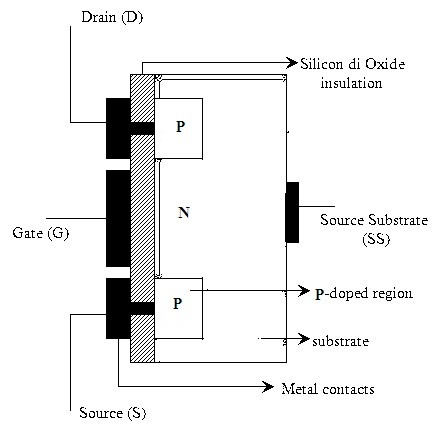
Depletion Layer Mosfet
The structure of a MOSFET varies based on the application i.e., MOSFETs in IC technology are fairly lateral, while the structure of Power MOSFETs is more of a vertical channel. Irrespective of the application, a MOSFET has basically three terminals namely Gate, Drain and Source.
If we consider an N-channel MOSFET, both the Source and Drain are made up of n-type, which sit in a P-type substrate.
Working of a MOSFET
Let us now try to understand how an n-Channel Enhancement Mode MOSFET works. In order to carry a drain current, there should be a channel between the drain and source regions of the MOSFET.
A channel is created when the voltage between gate and source terminals VGS is greater than the threshold voltage VTH.
When VGS > VTH, the device is said to be in triode (or constant resistance) region or saturation region depending on the voltage across drain and source terminals VDS.
For any VGS, if VDS < VGS – VTH, then the device is in triode region (also known as constant resistance or linear region). If VDS > VGS – VTH, then the device enters into saturation region.
When VGS < VTH, then the device is in off state. The gate current in either regions of operation is very less (almost equal to zero). Hence, MOSFET is known as Voltage Driven Device.
MOSFET Characteristics Curve
The image below shows the characteristic curve of MOSFET in three regions of operation. It depicts the Drain Current ID versus the Drain to Source Voltage VDS for a given Gate to Source Voltage VGS.
MOSFET Regions of Operation
Based on the above-mentioned working of a MOSFET, it can be concluded that a MOSFET has three regions of operation. They are:
- Cut-off Region
- Linear (or Triode) Region
- Saturation Region
A MOSFET operates in cut-off region when VGS < VTH. In this region, the MOSFET is in OFF state as there is no channel induced between drain and source.
For the channel to be induced and MOSFET to operate in either linear or saturation region, VGS > VTH.
The Gate – Drain bias voltage VGD will determine whether the MOSFET is in linear or saturation region. In both these regions, the MOSFET is in ON state but the difference is in linear region, the channel is continuous and the drain current is proportional to the resistance of the channel.
Coming to saturation region, as VDS > VGS – VTH, the channel pinches off i.e., it broadens resulting in a constant Drain Current.
Switching in Electronics
Semiconductor switching in electronic circuit is one of the important aspects. A semiconductor device like a BJT or a MOSFET are generally operated as switches i.e., they are either in ON state or in OFF state.
Ideal Switch Characteristics
For a semiconductor device, like a MOSFET, to act as an ideal switch, it must have the following features:
- During ON state, there should not be any limit on the amount of current it can carry.
- In OFF state, there should not be any limit on the blocking voltage.
- When the device is in ON state, there should be zero voltage drop.
- OFF state resistance should be infinite.
- Operating speed of the device has no limits.
Practical Switch Characteristics
But the World isn’t ideal and it is applicable even to our semiconductor switches. In a practical situation, a semiconductor device like a MOSFET has the following characteristics.
- During ON state, the power handling capabilities are limited i.e., limited conduction current. The blocking voltage during OFF state is also limited.
- Finite turn on and turn off times, which limit the switching speed. Maximum operating frequency is also limited.
- When the device is ON, there will be a finite on state resistance resulting in a forward voltage drop. There will also be a finite off state resistance which results in a reverse leakage current.
- A practical switch experiences power loses during on state, off state and also during the transition state (on to off or off to on).
Working of a MOSFET as a Switch
If you understood the working of the MOSFET and its regions of operation, you would have probably guessed how a MOSFET works as a switch. We will understand the operation of a MOSFET as a switch by considering a simple example circuit.
This is a simple circuit, where an N-Channel Enhancement mode MOSFET will turn ON or OFF a light. In order to operate a MOSFET as a switch, it must be operated in cut-off and linear (or triode) region.
Assume the device is initially OFF. The voltage across Gate and Source i.e., VGS is made appropriately positive (technically speaking, VGS > VTH), the MOSFET enters linear region and the switch is ON. This makes the Light to turn ON.
If the input Gate voltage is 0V (or technically < VTH), the MOSFET enters cut-off state and turns off. This in turn will make the light to turn OFF.
Example of MOSFET as a Switch
Consider a situation where you want to digitally control a 12W LED (12V @ 1A) using a Microcontroller. When you press a button connected to the microcontroller, the LED should turn ON. When you press the same button once again, the LED should turn OFF.
It is obvious that you cannot directly control the LED with the help of the microcontroller. You need a device that bridges the gap between the microcontroller and the LED.
This device should take in a control signal from the microcontroller (usually the voltage of this signal is in the working voltage range of the microcontroller, 5V for example) and supply power to the LED, which in this case is from a 12V supply.
The device which I am going to use is a MOSFET. The setup of the above-mentioned scenario is shown in the following circuit.
When a Logic 1 (assuming a 5V Microcontroller, Logic 1 is 5V and Logic 0 is 0V) is supplied to the gate of the MOSFET, it turns ON and allows drain current to flow. As a result, the LED is turned ON.
Similarly, when a Logic 0 is given to the gate of the MOSFET, it turns OFF and in turn switches OFF the LED.
Thus, you can digitally control a high-power device with the combination of Microcontroller and MOSFET.
Important Note
An important factor to consider is the power dissipation of the MOSFET. Consider a MOSFET with a Drain to Source Resistance of 0.1Ω. In the above case i.e., a 12W LED driven by a 12V supply will lead to a drain current of 1A.
Hence the power dissipated by the MOSFET is P = I2 * R = 1 * 0.1 = 0.1W.
This seems to be a low value but if you drive a motor using the same MOSFET, the situation is slightly different. The starting current (also called as in-rush current) of a motor will be very high.
So, even with RDS of 0.1Ω, the power dissipated during the start-up of a motor will still be significantly high, which may lead to thermal overload. Hence, RDS will be a key parameter to select a MOSFET for your application.
Also, when driving a motor, the back emf is an important factor that has to be considered while designing the circuit.
One of the main advantages of driving a motor with MOSFET is that an Input PWM signal can be used to smoothly control the speed of the motor.
Conclusion
A complete beginner’s tutorial on MOSFET as a Switch. You learned some important basics of MOSFET (its internal structure and regions of operations), ideal vs. practical Semiconductor switch, working of a MOSFET as a Switch, and couple of example circuits.
Related Posts: