
Summary: Still worry about your insufficient Mac storage? Want to speed up Mac but don't know how? Get the 6 free Mac cleaners to clear disk space, clean junk or duplicate files to free up your Mac.
- How To Clean System Storage In Mac Os
- How To Clean System Storage In Mac
- How To Clean System Storage On Mac
Many of us know exactly how to clean Windows computer or Android phone, but when it comes to cleaning Mac, few people know about it. Many Apple users think that, there is no need to clean Mac.
However, with more and more junk files occupying your Mac storage, your Mac will slow down and offer a bad performance. You have to rely on some Mac cleaner software to remove all useless data.
Best Free Mac Cleaners
This is how to clean up system files on Mac using iBeesoft iCleaner: Step 1: Run iCleaner for Mac Launch the system cleaner Mac program, and the home screen will open up.
Similar to the identification process, cleaning up can also be done in two ways. You can either go to each folder (that contributes to the Other storage) on your system and selectively delete the. It can include system files and caches, browser extensions, media files stored inside other applications, and files that are created by third-party apps. Files that cannot be fully identified and classified by Spotlight are grouped as Other storage. Ways to Clean Other Storage on Your Mac. Methods to clear system storage on Mac.Download CleanMyMac X free edition here:How to clean up Mac OS system storage:1. Downloads Folder. The Downloads folder is the default location on Mac that stores all the content.
With so many Mac cleaner tools offered on the market, which one you should use? Do you know how to choose a great Mac cleaner? We have tested more than 20 Mac cleaners and select the 6 best ones for you to choose from. You can pick your preferred Free Mac cleaner to speed up your Mac easily and quickly.
No.1 Free Mac cleaner: CCleaner - Free junk file cleaner
CCleaner is one free and top Mac cleaner to delete cookies, search history, temporary files and junk files from Mac. The specific functions are below:
1. Find and remove useless/junk files with the click of a button so your Mac can run faster. Speed up boot times with easy management of Startup items.
2. Clear up your recycle bin, temporary files and folders, broken permissions and others. If you want to remove installed programs, just click one button.
3. Erase your browser search history and cookies so you can browse any Internet confidentially and your identity remains anonymous.
How To Clean System Storage In Mac Os
No.2 Free Mac cleaner: Disk Inventory X – Free disk cleaner for Mac
Disk Inventory X is one disk cleaning software and disk usage utility for Mac. With this free Mac cleaner, you can know where your disk space has gone and clean it safely. Just see more about Disk Inventory X.
1. Disk Inventory X shows the sizes of files and folders in a special graphical way.
2. With this Mac cleaner, you can see different files marked with different colors, to help you easily find what you want to delete.
No.3 Free Mac cleaner: AVG Cleaner – Free hidden clutter cleaner
AVG Cleaner is one free Mac cleaner to clean hidden clutter and forgotten duplicates. You can see the detailed information below:
1. Clear more hidden garbage, log, download history and trash bin for freeing up more space on your Mac.
2. Search more duplicate files, including images, music, videos and folders.
3. Created for Mac and easy to use.
4. There is an anti-virus software called AVG AntiVirus for Mac, you can use it to protect Macs on your and your families.
No.4 Free Mac cleaner: OmniDiskSweeper - Free hard drive cleaner
OmniDiskSweeper is one free Mac cleaner to find and delete big files that taking up hard drive space and also it can help you recover lost disk space.
1. OmniDiskSweeper helps you sort every file on your Mac by size and you can identify the biggest file to delete it.
2. After deleting, remaining space and folders are recalculated.
No.5 Free Mac cleaner: Dr. Cleaner – Free memory, disk, system cleaner
Dr. Cleaner is one free Mac cleaning app to offer Memory Optimization, Disk Cleaning and System Monitoring to keep your Mac optimized for the best performance.
1. Smart and accurate selection for duplicates scan and remove on Mac with OS X 10.6.6 or later.
2. Scanned big files and junk files will be deleted easily from your Mac.
3. You can easily view real-time network usage and CPU usage in the Menu bar.
No.6 Free Mac cleaner: Disk Drill
Disk Drill is one very popular free Mac cleaner app. Actually, it is a professional data recovery tool for Mac, which carries some disk cleaning functions. It has the capability to analyze Mac storage space, locate unused, large, and duplicate files and so on. In this way, it enables you to free up your Mac storage effortlessly.
1. Monitor the health of your Mac storage and offer timely alerts.
2. Find and remove duplicate files in multiple locations on Mac.
3. Analyze disk space, locate unused files and space hogs, free up storage.
Professional Mac cleaner recommendation:
With the best 6 Mac cleaner apps above, you can handily remove some junk files and optimize your Mac performance. But some of them only offer trial features. Here you are recommended to directly choose the professional Mac cleaner below:
Mac Cleaner- Scan and delete junk files including cache data and logs, email attachments, unwanted iTunes backup and app localization.
- Delete large and old documents and selectively remove worthless files.
- Clean duplicated files or folders on Mac.
- Uninstall apps and clean associated files safely.
- Monitor Mac system in disk utilization, battery status, memory performance and CPU usage.
- Compatible with iMac, Mac Pro, MacBook (Air/Pro) in the latest macOS Big Sur.
FAQs of Free Mac Cleaner
How do I clean and optimize my Mac?
Download and install Aiseesoft Mac Cleaner. Click Cleaner and you can clean up your Mac by cleaning system junk, iPhoto junk, email junk, similar photos, iTunes junk, trash bin, large & old files and more.
Why is my Mac so slow?
The reason that why is your Mac so slow may includes there is no enough hard drive or RAM on Mac. Or there is too many startup items or icon clutter on desktop. Perhaps your macOS is outdated and you should update it.
Does Catalina slow down your Mac?
No. Catalina won’t slow down an old Mac. You can check to make sure if your Mac is compatible with macOS Catalina.
By now, 6 free Mac cleaners have been shared here. You can choose your preferred Mac cleaner according to your need. Please share it in comment if you have any better Mac cleaner recommendation. Check ere if you want to speed up your slow iPhone.
What do you think of this post?
Excellent
Rating: 4.8 / 5 (based on 238 ratings)
December 29, 2020 17:50 / Updated by Louisa White to Mac Cleanup
In this article, we’ll share with you some simple tips for improving the performance of your Mac and how to clear system storage. Mac can simply be outdated, or your hard disk is full. You may have too many things to start automatically at startup, or you may just be using too many programs at once.
Mac users are known for not shutting down their machines properly, so some apps may be running in the background for weeks. With some time and effort, you can successfully clean your Mac and help it run at full speed again.
Close unnecessary applications
It may sound too obvious, but the best step to start is to close programs that are running in the background that you are not using. A quick way to see which applications are running is to look at the Dock at the bottom of the screen. Programs that run will have a point below the icon.
There are several ways to turn off these applications: right-click (or Ctrl-click) their icons on the Dock, then click Quit; or if you use App Switcher, press Cmd-Q to turn off programs you are not using.
Use Activity Monitor to identify programs that are “eating” memory
Some applications by themselves draw more power and memory than others, and some have some issues that cause it.
To see which applications are drawing system resources, open Activity Monitor in the Utility folder. (Or press Cmd-Space and start typing “activity” and press Enter to open it from there).
Activity Monitor shows all the processes on your Mac – some of which you can’t and some of you should not close – so click View> Windowed Processes before doing anything.
Now click on the CPU button and the “% CPU” column to list all the programs, and see how much each processor uses. You can also see Memory, Disk and Network processes.
Prevent programs from running on Mac startup
Open System Preferences, and click Users & Groups. Now click on the Login tab to see what programs and services are running right when your Mac starts (or logs in).
Highlight an item you do not want in the list, and click the Delete from Login Items (-) button at the bottom of the list.
Check how much free space there is
Part of the performance of your Mac depends on the free space on your hard drive or (or flash) drive.
Mac defragmentation is unnecessary because Mac OS has built-in security measures that prevent files from fragmenting. This is probably why there is no option to defragment in Disk Utility.
There are many large files and folders on your hard drive. These include email files and backups, old versions of applications you no longer need, photos, and more. If you frequently upload photos to your Mac and download music frequently, you will probably be running out of space quickly.
Move your photos
It might surprise you to see how much space your Mac is taking up and photos and videos.
If you do not want to use one of the cloud services, a better idea would be to use a dedicated storage device and move the photos stored on your Mac there.
To do this, follow these steps:
- Turn off Photos.
- Copy Photo Library by dragging it from storage to an external drive.
- When done, hold down the Alt / Option key, and launch Photos.
- Select Photos> Preferences, and on the General tab, click Use as System Photo Library.
Move your music
The other big folder is probably your iTunes library, especially if you have movies, mobile apps as well as music.
As with photos, you can free up disk space by moving music files to an external disk.
Empty Trash and Downloads
The obvious way to free up space on your Mac is to empty Trash (right-click Trash on the Dock, and select Empty Trash).
You should also delete any items that you do not need from the Downloads folder. Click Downloads on the right side of the Dock, and on the arrow at the top to open the folder in Finder and see everything inside.
If you are using the latest version of Mac OS, you will be able to set Trash to delete items regularly. To do this, follow these steps:
- Click the Apple logo in the menu
- Select About this Mac
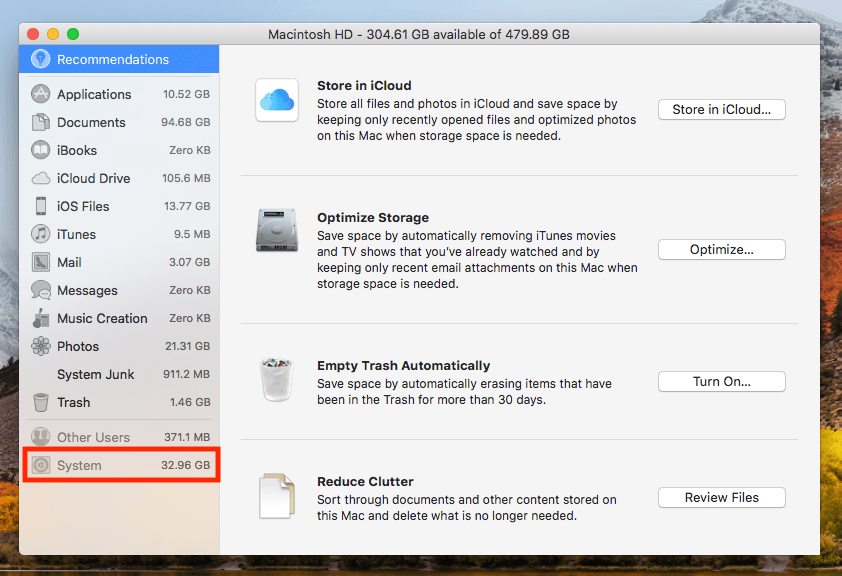
- Click Storage
- Click Manage
- Turn on Empty Trash Automatically (this will delete items from Trash after 30 days)
Delete old and large files
How To Clean System Storage In Mac
A quick way to reclaim a lot of space is to open Finder and select the All My Files option and then select sort by date or size.
Select Size and you can selectively delete the largest files.
Select the Date to selectively delete older files.
If your Finder window does not show sizes, go to View> Show View Options, and then select Size.
How To Clean System Storage On Mac
Empty the caches on your Mac
Macs use multiple caches, small files stored on the hard drive for reuse. As such, they can improve the performance of your Mac.
Some are system-controlled, others are controlled by individual applications. For example, a web browser will cache some web pages so that when you re-visit the site, the pages can be read from the hard drive instead of being retrieved.
View your user caches by pressing Command + Shift + G to display Go To Folder, then type ~ / Library / Caches /. Do not be surprised to find even a few gigabytes here. Most memory is likely to be earmarked for your web browser and accounts on Google Earth, iTunes, and Spotify.
Empty your Safari cache
Speaking of cache, it should be mentioned that Safari sometimes overflows with data. Cleaning your browser will help speed up Safari on MacOS.
Open Safari and select Safari> Reset Safari and select Remove all Website Data. (Leave the second option unchecked.)
Now click on Reset. This can help speed up web searches.