
-->
The Azure Terraform Visual Studio Code extension enables you to work with Terraform from the editor. With this extension, you can author, test, and run Terraform configurations. The extension also supports resource graph visualization.
In this article, you learn how to:
On the left hand side of Visual Studio code, click the Find and Replace menu. Search for orgName. In the first result found in project-scratch-def.json. Change the orgName value (after the: and in between the “”) to Learning VS Code. Save the file by pressing Command + S on Mac, Control + S on Windows. Visual Studio Code is a code editor redefined and optimized for building and debugging modern web and cloud applications. Visual Studio Code is free and available on your favorite platform.
- Automate the provisioning of Azure services using Terraform
- install and use the Terraform Visual Studio Code extension for Azure services.
- Use Visual Studio Code to write, plan, and execute Terraform plans.
Prerequisites
- Azure subscription: If you don't have an Azure subscription, create a free account before you begin.
- Terraform: Install and configure Terraform.
- Visual Studio Code: Install the version of Visual Studio Code that is appropriate for your environment.
Prepare your dev environment
Install Git
To complete the exercises in the article, you need to install Git.
Install HashiCorp Terraform
Follow the instructions on the HashiCorp Install Terraform webpage, which covers:
- Downloading Terraform
- Installing Terraform
- Verifying Terraform is correctly installed
Tip
Be sure to follow the instructions regarding setting your PATH system variable.
Install Node.js
To use Terraform in the Cloud Shell, you need to install Node.js 6.0+.
Note
To verify if Node.js is installed, open a terminal window and enter node -v.
Install GraphViz
To use the Terraform visualize function, you need to install GraphViz.
Note
To verify if GraphViz is installed, open a terminal window and enter dot -V.
Install the Azure Terraform Visual Studio Code extension
Launch Visual Studio Code.
Select Extensions.
Use the Search Extensions in Marketplace text box to search for the Azure Terraform extension:
Select Install.
Note
When you select Install for the Azure Terraform extension, Visual Studio Code will automatically install the Azure Account extension. Azure Account is a dependency file for the Azure Terraform extension, which it uses to perform Azure subscription authentications and Azure-related code extensions.
Verify the Terraform extension is installed in Visual Studio Code
Select Extensions.
Enter
@installedin the search text box.
The Azure Terraform extension will appear in the list of installed extensions.
You can now run all supported Terraform commands in your Cloud Shell environment from within Visual Studio Code.
Exercise 1: Basic Terraform commands walk-through
In this exercise, you create and execute a basic Terraform configuration file that provisions a new Azure resource group.
Prepare a test plan file
In Visual Studio Code, select File > New File from the menu bar.
In your browser, navigate to the Terraform azurerm_resource_group page and copy the code in the Example Usage code block:
Paste the copied code into the new file you created in Visual Studio Code.
Note
You may change the name value of the resource group, but it must be unique to your Azure subscription.
From the menu bar, select File > Save As.
In the Save As dialog, navigate to a location of your choice and then select New folder. (Change the name of the new folder to something more descriptive than New folder.)
Note
In this example, the folder is named TERRAFORM-TEST-PLAN.
Make sure your new folder is highlighted (selected) and then select Open.
In the Save As dialog, change the default name of the file to main.tf.
Select Save.
In the menu bar, select File > Open Folder. Navigate to and select the new folder you created.
Run Terraform init command
Launch Visual Studio Code.
From the Visual Studio Code menu bar, select File > Open Folder.. and locate and select your main.tf file.
From the menu bar, select View > Command Palette.. > Azure Terraform: Init.
When the confirmation appears, select OK.
The first time you launch Cloud Shell from a new folder, you're prompted to create a web application. Select Open.
The Welcome to Azure Cloud Shell page opens. Select Bash or PowerShell.
If you have not already set up an Azure storage account, the following screen appears. Select Create storage.
Azure Cloud Shell launches in the shell you previously selected and displays information for the cloud drive it just created for you.
You may now exit the Cloud Shell
From the menu bar, select View > Command Palette > Azure Terraform: init.
Visualize the plan
Earlier in this article, you installed GraphViz. Terraform can use GraphViz to generate a visual representation of either a configuration or execution plan. The Azure Terraform Visual Studio Code extension implements this feature via the visualize command.
From the menu bar, select View > Command Palette > Azure Terraform: Visualize.
Run Terraform plan command
The Terraform plan command is used to check whether the execution plan for a set of changes will do what you intended.
Note
Terraform plan does not make any changes to your real Azure resources. To actually make the changes contained in your plan, we use the Terraform apply command.
From the menu bar, select View > Command Palette > Azure Terraform: plan.
Run Terraform apply command
After being satisfied with the results of Terraform plan, you can run the apply command.
From the menu bar, select View > Command Palette > Azure Terraform: apply.
Font to download for mac. Enter
yes.
Verify your Terraform plan was executed
To see if your new Azure resource group was successfully created:
Open the Azure portal.
Select Resource groups in the left navigation pane.
Your new resource group should be listed in the NAME column.
Note
You may leave your Azure Portal window open for now; we will be using it in the next step.
Run Terraform destroy command
From the menu bar, select View > Command Palette > Azure Terraform: destroy.
Enter yes.
Verify your resource group was destroyed
To confirm that Terraform successfully destroyed your new resource group:
Select Refresh on the Azure portal Resource groups page.
Your resource group will no longer be listed.
Exercise 2: Terraform compute module

In this exercise, you learn how to load the Terraform compute module into the Visual Studio Code environment.
Clone the terraform-azurerm-compute module
Use this link to access the Terraform Azure Rm Compute module on GitHub.
Select Clone or download.
Note
In this example, our folder was named terraform-azurerm-compute.
Open the folder in Visual Studio Code
Launch Visual Studio Code.
From the menu bar, select File > Open Folder and navigate to and select the folder you created in the previous step.
Initialize Terraform
Before you can begin using the Terraform commands from within Visual Studio Code, you download the plug-ins for two Azure providers: random and azurerm.
In the Terminal pane of the Visual Studio Code IDE, enter
terraform init.Enter
az login, press <Enter, and follow the on-screen instructions.
Module test: lint
From the menu bar, select View > Command Palette > Azure Terraform: Execute Test.
From the list of test-type options, select lint.
When the confirmation appears, select OK, and follow the on-screen instructions.
Note
When you execute either the lint or end to end test, Azure uses a container service to provision a test machine to perform the actual test. For this reason, your test results may typically take several minutes to be returned.
After a few moments, you see a listing in the Terminal pane similar to this example:
Test the module
From the menu bar, select View > Command Palette > Azure Terraform: Execute Test.
From the list of test type options, select end to end.
When the confirmation appears, select OK, and follow the on-screen instructions.
Note
When you execute either the lint or end to end test, Azure uses a container service to provision a test machine to perform the actual test. For this reason, your test results may typically take several minutes to be returned.
After a few moments, you see a listing in the Terminal pane similar to this example:
Troubleshooting
For Terraform-specific support, use one of HashiCorp's community support channels to Terraform:
- Questions, use-cases, and useful patterns: Terraform section of the HashiCorp community portal
- Provider-related questions: Terraform Providers section of the HashiCorp community portal
Next steps
In this tutorial, you use Python 3 to create the simplest Python 'Hello World' application in Visual Studio Code. By using the Python extension, you make VS Code into a great lightweight Python IDE (which you may find a productive alternative to PyCharm).
This tutorial introduces you to VS Code as a Python environment, primarily how to edit, run, and debug code through the following tasks:
- Write, run, and debug a Python 'Hello World' Application
- Learn how to install packages by creating Python virtual environments
- Write a simple Python script to plot figures within VS Code
This tutorial is not intended to teach you Python itself. Once you are familiar with the basics of VS Code, you can then follow any of the programming tutorials on python.org within the context of VS Code for an introduction to the language.
If you have any problems, feel free to file an issue for this tutorial in the VS Code documentation repository.

Prerequisites
To successfully complete this tutorial, you need to first setup your Python development environment. Specifically, this tutorial requires:
- VS Code
- VS Code Python extension
- Python 3
Install Visual Studio Code and the Python Extension
If you have not already done so, install VS Code.
Next, install the Python extension for VS Code from the Visual Studio Marketplace. For additional details on installing extensions, see Extension Marketplace. The Python extension is named Python and it's published by Microsoft.
Install a Python interpreter
Along with the Python extension, you need to install a Python interpreter. Which interpreter you use is dependent on your specific needs, but some guidance is provided below.
Windows
Install Python from python.org. You can typically use the Download Python button that appears first on the page to download the latest version.
Note: If you don't have admin access, an additional option for installing Python on Windows is to use the Microsoft Store. The Microsoft Store provides installs of Python 3.7, Python 3.8, and Python 3.9. Be aware that you might have compatibility issues with some packages using this method.
For additional information about using Python on Windows, see Using Python on Windows at Python.org
macOS
The system install of Python on macOS is not supported. Instead, an installation through Homebrew is recommended. To install Python using Homebrew on macOS use brew install python3 at the Terminal prompt.
Note On macOS, make sure the location of your VS Code installation is included in your PATH environment variable. See these setup instructions for more information.
Linux
The built-in Python 3 installation on Linux works well, but to install other Python packages you must install pip with get-pip.py.
Other options
Data Science: If your primary purpose for using Python is Data Science, then you might consider a download from Anaconda. Anaconda provides not just a Python interpreter, but many useful libraries and tools for data science.
Windows Subsystem for Linux: If you are working on Windows and want a Linux environment for working with Python, the Windows Subsystem for Linux (WSL) is an option for you. If you choose this option, you'll also want to install the Remote - WSL extension. For more information about using WSL with VS Code, see VS Code Remote Development or try the Working in WSL tutorial, which will walk you through setting up WSL, installing Python, and creating a Hello World application running in WSL.
Verify the Python installation
To verify that you've installed Python successfully on your machine, run one of the following commands (depending on your operating system):
Linux/macOS: open a Terminal Window and type the following command:
Windows: open a command prompt and run the following command:
If the installation was successful, the output window should show the version of Python that you installed.
Note You can use the py -0 command in the VS Code integrated terminal to view the versions of python installed on your machine. The default interpreter is identified by an asterisk (*).
Start VS Code in a project (workspace) folder
Using a command prompt or terminal, create an empty folder called 'hello', navigate into it, and open VS Code (code) in that folder (.) by entering the following commands:
Note: If you're using an Anaconda distribution, be sure to use an Anaconda command prompt.
By starting VS Code in a folder, that folder becomes your 'workspace'. VS Code stores settings that are specific to that workspace in .vscode/settings.json, which are separate from user settings that are stored globally.
Alternately, you can run VS Code through the operating system UI, then use File > Open Folder to open the project folder.
Select a Python interpreter
Python is an interpreted language, and in order to run Python code and get Python IntelliSense, you must tell VS Code which interpreter to use.
From within VS Code, select a Python 3 interpreter by opening the Command Palette (⇧⌘P (Windows, Linux Ctrl+Shift+P)), start typing the Python: Select Interpreter command to search, then select the command. You can also use the Select Python Environment option on the Status Bar if available (it may already show a selected interpreter, too):
The command presents a list of available interpreters that VS Code can find automatically, including virtual environments. If you don't see the desired interpreter, see Configuring Python environments.
Note: When using an Anaconda distribution, the correct interpreter should have the suffix ('base':conda), for example Python 3.7.3 64-bit ('base':conda).
Selecting an interpreter sets the python.pythonPath value in your workspace settings to the path of the interpreter. To see the setting, select File > Preferences > Settings (Code > Preferences > Settings on macOS), then select the Workspace Settings tab.
Note: If you select an interpreter without a workspace folder open, VS Code sets python.pythonPath in your user settings instead, which sets the default interpreter for VS Code in general. The user setting makes sure you always have a default interpreter for Python projects. The workspace settings lets you override the user setting.
Create a Python Hello World source code file
From the File Explorer toolbar, select the New File button on the hello folder:
Name the file hello.py, and it automatically opens in the editor:
By using the .py file extension, you tell VS Code to interpret this file as a Python program, so that it evaluates the contents with the Python extension and the selected interpreter.
Note: The File Explorer toolbar also allows you to create folders within your workspace to better organize your code. You can use the New folder button to quickly create a folder.
Now that you have a code file in your Workspace, enter the following source code in hello.py:
When you start typing print, notice how IntelliSense presents auto-completion options.
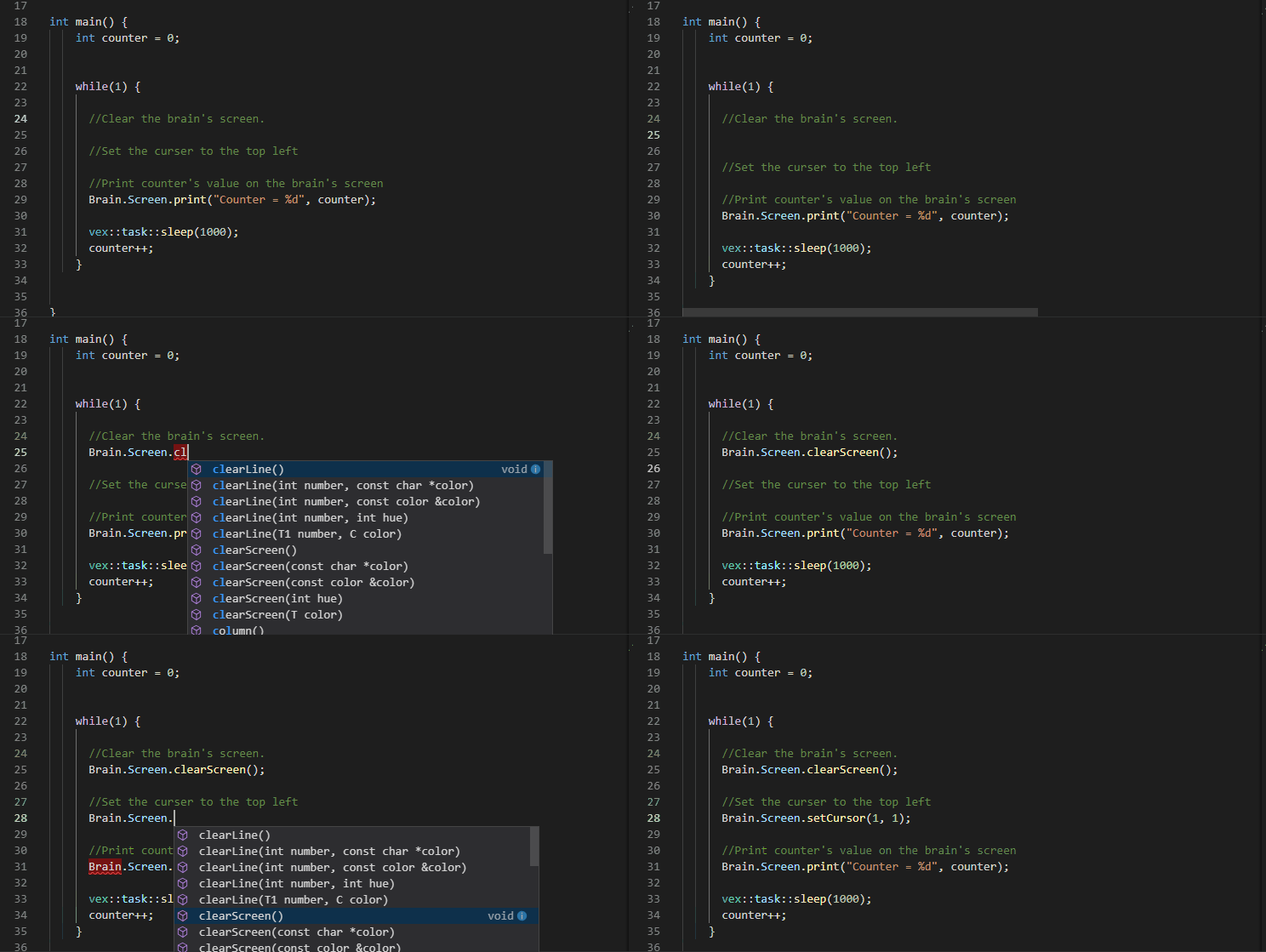
IntelliSense and auto-completions work for standard Python modules as well as other packages you've installed into the environment of the selected Python interpreter. It also provides completions for methods available on object types. For example, because the msg variable contains a string, IntelliSense provides string methods when you type msg.:
Feel free to experiment with IntelliSense some more, but then revert your changes so you have only the msg variable and the print call, and save the file (⌘S (Windows, Linux Ctrl+S)).
For full details on editing, formatting, and refactoring, see Editing code. The Python extension also has full support for Linting.
Run Hello World
It's simple to run hello.py with Python. Just click the Run Python File in Terminal play button in the top-right side of the editor.
The button opens a terminal panel in which your Python interpreter is automatically activated, then runs python3 hello.py (macOS/Linux) or python hello.py (Windows):
There are three other ways you can run Python code within VS Code:
Right-click anywhere in the editor window and select Run Python File in Terminal (which saves the file automatically):
Select one or more lines, then press Shift+Enter or right-click and select Run Selection/Line in Python Terminal. This command is convenient for testing just a part of a file.
From the Command Palette (⇧⌘P (Windows, Linux Ctrl+Shift+P)), select the Python: Start REPL command to open a REPL terminal for the currently selected Python interpreter. In the REPL, you can then enter and run lines of code one at a time.
Configure and run the debugger
Let's now try debugging our simple Hello World program.
First, set a breakpoint on line 2 of hello.py by placing the cursor on the print call and pressing F9. Alternately, just click in the editor's left gutter, next to the line numbers. When you set a breakpoint, a red circle appears in the gutter.
Next, to initialize the debugger, press F5. Since this is your first time debugging this file, a configuration menu will open from the Command Palette allowing you to select the type of debug configuration you would like for the opened file.
Note: VS Code uses JSON files for all of its various configurations; launch.json is the standard name for a file containing debugging configurations.
These different configurations are fully explained in Debugging configurations; for now, just select Python File, which is the configuration that runs the current file shown in the editor using the currently selected Python interpreter.
The debugger will stop at the first line of the file breakpoint. The current line is indicated with a yellow arrow in the left margin. If you examine the Local variables window at this point, you will see now defined msg variable appears in the Local pane.
A debug toolbar appears along the top with the following commands from left to right: continue (F5), step over (F10), step into (F11), step out (⇧F11 (Windows, Linux Shift+F11)), restart (⇧⌘F5 (Windows, Linux Ctrl+Shift+F5)), and stop (⇧F5 (Windows, Linux Shift+F5)).
The Status Bar also changes color (orange in many themes) to indicate that you're in debug mode. The Python Debug Console also appears automatically in the lower right panel to show the commands being run, along with the program output.
To continue running the program, select the continue command on the debug toolbar (F5). The debugger runs the program to the end.
Tip Debugging information can also be seen by hovering over code, such as variables. In the case of msg, hovering over the variable will display the string Hello world in a box above the variable.
You can also work with variables in the Debug Console (If you don't see it, select Debug Console in the lower right area of VS Code, or select it from the .. menu.) Then try entering the following lines, one by one, at the > prompt at the bottom of the console:
Select the blue Continue button on the toolbar again (or press F5) to run the program to completion. 'Hello World' appears in the Python Debug Console if you switch back to it, and VS Code exits debugging mode once the program is complete.
If you restart the debugger, the debugger again stops on the first breakpoint.
To stop running a program before it's complete, use the red square stop button on the debug toolbar (⇧F5 (Windows, Linux Shift+F5)), or use the Run > Stop debugging menu command.
For full details, see Debugging configurations, which includes notes on how to use a specific Python interpreter for debugging.
Tip: Use Logpoints instead of print statements: Developers often litter source code with print statements to quickly inspect variables without necessarily stepping through each line of code in a debugger. In VS Code, you can instead use Logpoints. A Logpoint is like a breakpoint except that it logs a message to the console and doesn't stop the program. For more information, see Logpoints in the main VS Code debugging article.
Install and use packages
Let's now run an example that's a little more interesting. In Python, packages are how you obtain any number of useful code libraries, typically from PyPI. For this example, you use the matplotlib and numpy packages to create a graphical plot as is commonly done with data science. (Note that matplotlib cannot show graphs when running in the Windows Subsystem for Linux as it lacks the necessary UI support.)
Return to the Explorer view (the top-most icon on the left side, which shows files), create a new file called standardplot.py, and paste in the following source code:
Tip: If you enter the above code by hand, you may find that auto-completions change the names after the as keywords when you press Enter at the end of a line. To avoid this, type a space, then Enter.
Next, try running the file in the debugger using the 'Python: Current file' configuration as described in the last section.
Visual Studio Code Insiders
Unless you're using an Anaconda distribution or have previously installed the matplotlib package, you should see the message, 'ModuleNotFoundError: No module named 'matplotlib'. Such a message indicates that the required package isn't available in your system.
To install the matplotlib package (which also installs numpy as a dependency), stop the debugger and use the Command Palette to run Terminal: Create New Integrated Terminal (⌃⇧` (Windows, Linux Ctrl+Shift+`)). This command opens a command prompt for your selected interpreter.
Visual Studio Code For Beginners
A best practice among Python developers is to avoid installing packages into a global interpreter environment. You instead use a project-specific virtual environment that contains a copy of a global interpreter. Once you activate that environment, any packages you then install are isolated from other environments. Such isolation reduces many complications that can arise from conflicting package versions. To create a virtual environment and install the required packages, enter the following commands as appropriate for your operating system:
How To Use Vscode
Note: For additional information about virtual environments, see Environments.
Create and activate the virtual environment
Note: When you create a new virtual environment, you should be prompted by VS Code to set it as the default for your workspace folder. If selected, the environment will automatically be activated when you open a new terminal.
For Windows
If the activate command generates the message 'Activate.ps1 is not digitally signed. You cannot run this script on the current system.', then you need to temporarily change the PowerShell execution policy to allow scripts to run (see About Execution Policies in the PowerShell documentation):
For macOS/Linux
Select your new environment by using the Python: Select Interpreter command from the Command Palette.
Install the packages
Rerun the program now (with or without the debugger) and after a few moments a plot window appears with the output:
Once you are finished, type
deactivatein the terminal window to deactivate the virtual environment.
For additional examples of creating and activating a virtual environment and installing packages, see the Django tutorial and the Flask tutorial.
Next steps
You can configure VS Code to use any Python environment you have installed, including virtual and conda environments. You can also use a separate environment for debugging. For full details, see Environments. Canon mf4410 for mac.
To learn more about the Python language, follow any of the programming tutorials listed on python.org within the context of VS Code.

To learn to build web apps with the Django and Flask frameworks, see the following tutorials:
There is then much more to explore with Python in Visual Studio Code:
- Editing code - Learn about autocomplete, IntelliSense, formatting, and refactoring for Python.
- Linting - Enable, configure, and apply a variety of Python linters.
- Debugging - Learn to debug Python both locally and remotely.
- Testing - Configure test environments and discover, run, and debug tests.
- Settings reference - Explore the full range of Python-related settings in VS Code.