
- Sep 18, 2020 To install Wireshark run this command from the Terminal: brew install wireshark. Homebrew will download and install Wireshark and any dependencies so it will run correctly. Wireshark for Linux. Installing Wireshark on Linux can be a little different depending on the Linux distribution.
- $ brew install wireshark -with-qt $ sudo wireshark 2 /dev/null & 動いた!
Wireshark is the world’s foremost and widely-used network protocol analyzer. It lets you see what’s happening on your network at a microscopic level and is the de facto (and often de jure) standard across many commercial and non-profit enterprises, government agencies, and educational institutions. By Date By Thread. Current thread: Installing wireshark on MacOS Catalina via brew varun siripurapu (Mar 13). Re: Installing wireshark on MacOS Catalina via brew Guy Harris (Mar 13). To work, Termshark needs TShark to be installed. This is part of Wireshark, and on macOS you can install it using brew (brew install wireshark). On Linux the package name depends on the distribution you're using. For example it's tshark on Debian / Ubuntu, while the package that provides TShark on Fedora is called wireshark-cli.
About the App
- App name: wireshark
- App description: Graphical network analyzer and capture tool
- App website: https://www.wireshark.org
Install the App
- Press
Command+Spaceand type Terminal and press enter/return key. - Run in Terminal app:
ruby -e '$(curl -fsSL https://raw.githubusercontent.com/Homebrew/install/master/install)' < /dev/null 2> /dev/null
and press enter/return key.
If the screen prompts you to enter a password, please enter your Mac's user password to continue. When you type the password, it won't be displayed on screen, but the system would accept it. So just type your password and press ENTER/RETURN key. Then wait for the command to finish. - Run:
brew install wireshark
Done! You can now use wireshark.
Similar Software for Mac
It can be difficult to trace network traffic from a Node.js application.Typically, folks will just instrument some logging to check that everything isworking as it is supposed to. Unfortunately, sometimes there are too manyabstractions or possible race conditions to accurately get a good trace. To getthe most objective possible trace of network traffic Wireshark can be used.
Wireshark is a network protocol analyzer that makes it extremely simple tocapture and trace network activity from any source on your computer. It also hastools built in to decrypt traffic like that of HTTPS (TLS / SSL).
Setup
In the case of capturing HTTPS (TLS / SSL) traffic, there is some setup beforecapturing traffic. If all you need is to capture unencrypted HTTP, then skip tothe Wireshark installation, since Wireshark can do so out-of-the-box.
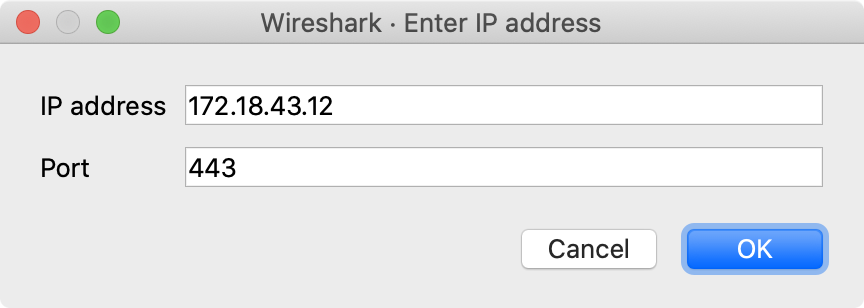
SSL key logging for HTTPS (TLS / SSL) decryption
If you'd like to decrypt HTTPS (TLS / SSL) you will need to set a path via anenvironmental variable to collect SSL keys for use in Wireshark. This sameenvironmental variable works for most browsers and some other applications aswell.
Set the path and file name to whatever you would like.
Node.js SSL key logging
Node.js v12.3.0 introduced a keylog API to store SSL keys, but it can beunwieldy to setup and integrate with existing libraries. It also does not workwith the SSLKEYLOGFILE environmental variable. Luckily, there is a simple wayto set up using an npm module: sslkeylog. sslkeylog sets up global hooksinto the https module to capture any SSL keys used which makes it therecommended way of capturing SSL keys. sslkeylog can be installed with npmlike below:
Once sslkeylog is installed, import it and active its hooks before making anyHTTP(S) calls. For example:
If you use TypeScript, you may need to include a declaration file like below:
Once capturing traffic is complete, you can remove all the code related to SSLkey logging.
Wireshark
First things first, you must install Wireshark program. On macOS you can usebrew to not only install the CLI, but the UI app as well:
For Wireshark to be able to decrypt HTTPS (TLS / SSL) traffic it needs to readthe SSL Key log generated by Node.js or other applications. To configure thisfor Wireshark, open up the application and then open the preferences forWireshark. Once the preferences are open, open the 'Protocols' dropdown in theleft sidebar menu listing and scroll down to 'TLS', then click on it. On olderversions of Wireshark, look for 'SSL' instead of 'TLS'. Once the settings for'TLS' (or 'SSL' for older versions) is open, look for the '(Pre)-Master-Secretlog filename' setting and set the path to the same one that was configured abovevia the SSLKEYLOGFILE environmental variable. You might need to create anempty file at the path given.
Capturing traffic

Now that you are all setup, you can begin capturing traffic. Open up Wiresharkand select the capture interface, which for macOS is usually en0 (Wi-Fi).
Once capturing has begun you should start to see logs of all sorts of trafficto be listed, unless you are not connected to the internet.
This traffic can be overwhelming and mostly unrelated to Node.js or theapplication you are trying to inspect. This where filters come in handy.


For example, to filter requests on a domain:
Or to filter on a certain IP address:
Filters can also be combined with conditional operators && and ||.
Once capturing has begun, you can start your app up as normal and try to causenetwork activity that is in need of being traced.
Hopefully, with a combination with the filters you will be able to find theexact requests and responses you are looking for. If you find either a requestor a response you can right click on a line item and select 'Follow > HTTPStream' to see the both of the request and response.
Wireshark Brew 10
Additionally, you can save any traffic captured for later use or to send topeers for inspection.